AI Claims Processing Software That Keeps Your Adjusters in Charge
Documents extracted, coverage verified, fraud indicators scored, reserve suggested - a full recommendation packet in under two minutes. Your adjuster reviews the analysis, validates it, and makes the call. Every AI action is logged, sourced, and reviewable.
.jpg)
What Is AI Claims Processing Software?
AI claims processing software reads the unstructured material that arrives with a claim - FNOL forms, police reports, medical bills, photographs, contractor estimates - extracts the facts, checks them against the policy and against outside data sources, and assembles a structured recommendation for the adjuster. It does not decide the claim. In a governed deployment, the software produces the analysis and the evidence behind it; the licensed claims professional determines coverage, sets the reserve, approves the payment, and owns the outcome.
Your Adjusters Were Hired for Judgment. They Spend Their Day on Data Entry.
The work that requires a licensed professional - reading the policy against the facts, weighing conflicting evidence, deciding what the carrier owes - is not what fills an adjuster’s day. Document gathering, re-keying, and system lookups are. Meanwhile the policyholder waits, exposure develops unnoticed, and regulators keep raising the bar on what documented AI governance actually means.
3 to 7 days from FNOL to decision
Top performers close clean auto files in roughly six hours. The gap is not adjuster skill - it is how long it takes to assemble a complete file. Cycle time is the single strongest driver of claims satisfaction, and every additional day costs NPS, raises litigation risk, and puts the renewal at risk.
60%+ of adjuster time goes to administrative work
Gathering documents, re-keying data, looking things up in three systems. This is the work AI should absorb - so experienced adjusters can be redirected to the complex, high-severity files where their judgment actually changes the outcome.
24+ jurisdictions expect documented AI governance
The NAIC Model Bulletin on the Use of Artificial Intelligence Systems by Insurers requires carriers to maintain a documented AIS Program covering governance, controls, validation, and evidence supporting AI-influenced decisions. It has been adopted by more than 24 U.S. jurisdictions, and the NAIC’s AI Systems Evaluation Tool entered a 12-state pilot in January 2026. If you cannot show your work, the model is a liability.
The Configurable Intelligence Core: Three Layers Between FNOL and Your Adjuster’s Desk
Most claims AI on the market is a language model with an insurance-shaped interface. That works until a state regulator asks which rule version produced a given routing decision, or until a business analyst needs to change a fraud weight and the answer is a six-week IT release. Claims AI is built as three separate, independently deployable layers - extraction, deterministic logic, and human decision - because those three things fail differently and need to be governed differently.
AI Claims Intelligence
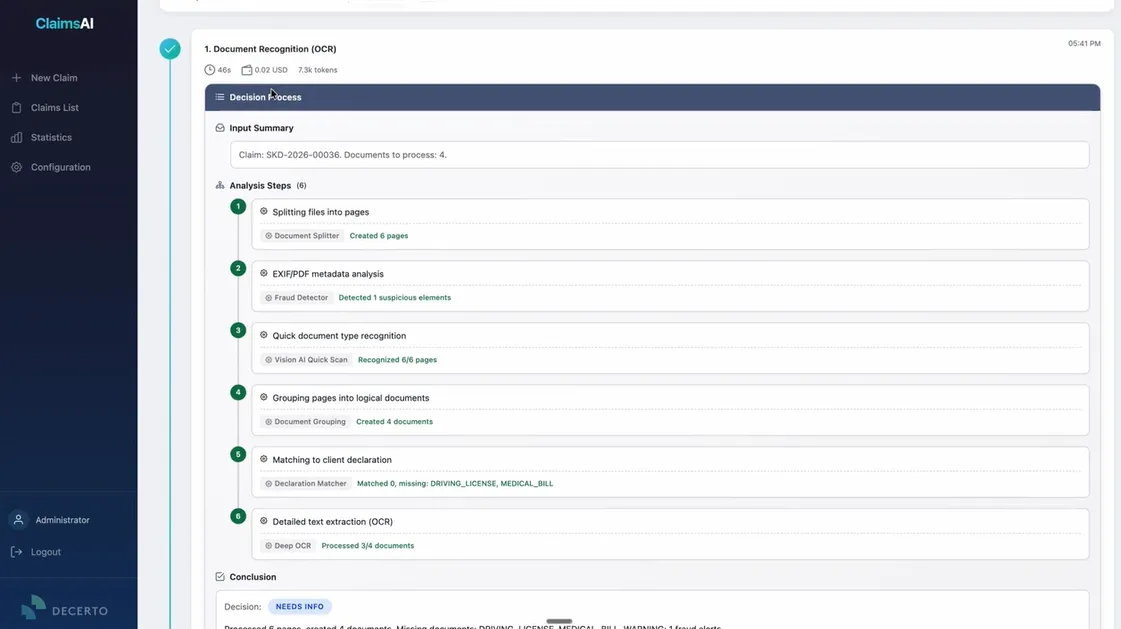
The first layer takes whatever arrives - FNOL submissions, police reports, medical bills, photographs, handwritten notes, contractor estimates - and turns it into a structured data model. It extracts entities, assigns roles to the parties, and cross-references what it found against outside sources such as weather services and motor vehicle records. Every extracted field carries a confidence value. Fields below the configured threshold are routed to the adjuster for verification rather than passed downstream as fact. On a typical file this removes roughly 70 minutes of manual data gathering.
Human review point: the adjuster sees what was extracted, what source it came from, and what the system could not read.
Higson Rules Engine
This is where claims governance lives. The Higson rules engine takes the structured output from Layer 1 and applies your business logic - state-specific SLAs, authority limits, weighted fraud scoring, escalation thresholds. Deterministic, versioned, and auditable: the same inputs produce the same outputs, every time, and the rule version that produced each action is recorded. Business analysts adjust fraud weights, routing thresholds, and compliance rules directly. No ticket, no release train. The engine generates tasks, routes referrals, and places hard stops on payments that exceed configured authority.
Human review point: every rule-driven action is attributed, timestamped, and traceable to a specific rule version.
Adjuster Workspace
The adjuster receives a prioritized task in a unified, line-of-business-agnostic queue: the structured summary, the highlighted policy language, the rules-engine flags, and the open questions. From there they validate coverage, set the reserve, and approve the settlement. Final authority always stays with the human. The workspace records the decision, the reasoning, the authority level of the person who made it, and whether they accepted, modified, or rejected each part of the AI-supported analysis.
Human review point: this is the decision. Everything before it was preparation.
How Does AI Claims Processing Work, Step by Step?
Nine stages run between the moment a claim arrives and the moment it reaches an adjuster’s queue. Eight of them are analysis and organization. The ninth is a decision, and it belongs to a person.
Document intake and extraction
The system processes PDFs, photographs, and handwritten notes, and describes what it sees in images - water staining on a ceiling, buckled decking, impact location on a vehicle. Each extracted field is scored for confidence, and low-confidence extractions are flagged for adjuster verification rather than treated as established fact.
Contextual analysis (NLP)
Rather than matching keywords, the system reads for meaning: policy number, date of loss, cause of loss, parties involved, and their roles. The submission is classified by line of business and claim type, which determines which downstream rules apply.
Coverage verification
The system connects to your policy administration system and confirms the policy was in force on the date of loss. Where coverage has lapsed or premium is past due, the file is routed as an administrative exception before it consumes adjuster time.
Endorsement and rider review
Scanned endorsements and riders that exist only on paper - never keyed into the core system - are located and read. These are the provisions that most often surface late, after a position has already been communicated.
Completeness check
The system checks the file against thedocumentation requirements for that claim type and jurisdiction, and drafts arequest for the missing items. The adjuster reviews and releases the request.
Fraud indicator scoring
Metadata and EXIF analysis identifies signsof image manipulation, checks photograph geolocation against the reported losslocation, and surfaces duplicate documents seen on prior claims. The rulesengine combines these into a weighted score using your fraud weights. The system identifies indicators. It doesnot determine that fraud occurred. The adjuster or SIU professional reviews theindicators and decides whether a referral is warranted.
Policy language identification
The system searches the policy form,endorsements, and exclusions, and surfaces the specific provisions relevant tothe reported facts - with the language quoted and the source document linked. Where provisions conflict or the facts are incomplete, it says so rather thanresolving the ambiguity itself.
Valuation support
Line-specific logic - personal accident, homeowners, auto - calculates an indicated amount against impairment schedules, fee schedules, and invoice verification, and shows the arithmetic. The adjuster evaluates whether the indication reflects the file.
The adjuster decides
The recommendation packet arrives with a draft communication to the claimant attached. The adjuster reviews the analysis, checks the evidence behind it, and accepts, modifies, or rejects each element. They set the coverage position, the reserve, and the payment. Their name, authority level, comments, and timestamp go into the record alongside the AI output they acted on.
Who Decides What
AI-supported analysis is decision support. Regulated claim decisions belong to licensed claims professionals operating inside your authority structure. Here is where that line sits, and how the product shows it.
AI analyzes. Your adjusters decide.
This is the line that matters most to a U.S. claims organization, so we draw it in the workflow rather than in a footnote. The platform does the analysis and assembles the evidence. The licensed professional makes the call and owns the outcome.
What Claims AI Does: Analyzes and summarizes, organizes documents and evidence, comparesinformation across the file, identifies inconsistencies, prioritizes tasks andreferrals, prepares draft correspondence, and routes matters for the rightlevel of review.
What the Adjuster Owns: Coverage determinations, liability and comparative negligence, reserve establishment and changes, settlement evaluations, denials, fraud and SIU referrals, payment approvals, litigation strategy, and claim closure.
Visible in the Work: Every task carries an execution type. AI-executed checks, system-executed steps, and human-executed decisions sit in the same list, labeled, with the responsible person named against each one.
No Silent Automation: Actions that exceed a user’s configured authority do not proceed quietly. They route to the reviewer who holds that authority, and the referral stays on the file.
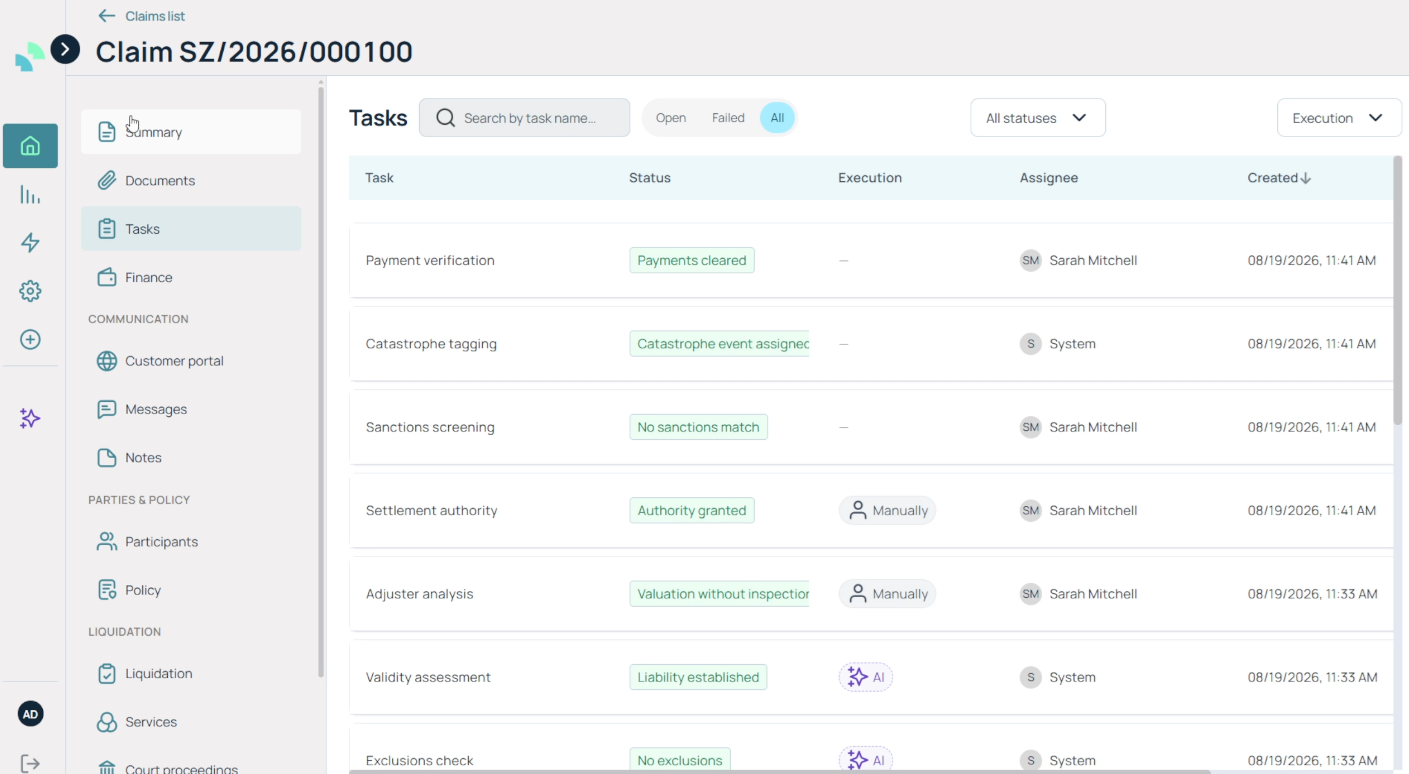
Every recommendation stops at a person
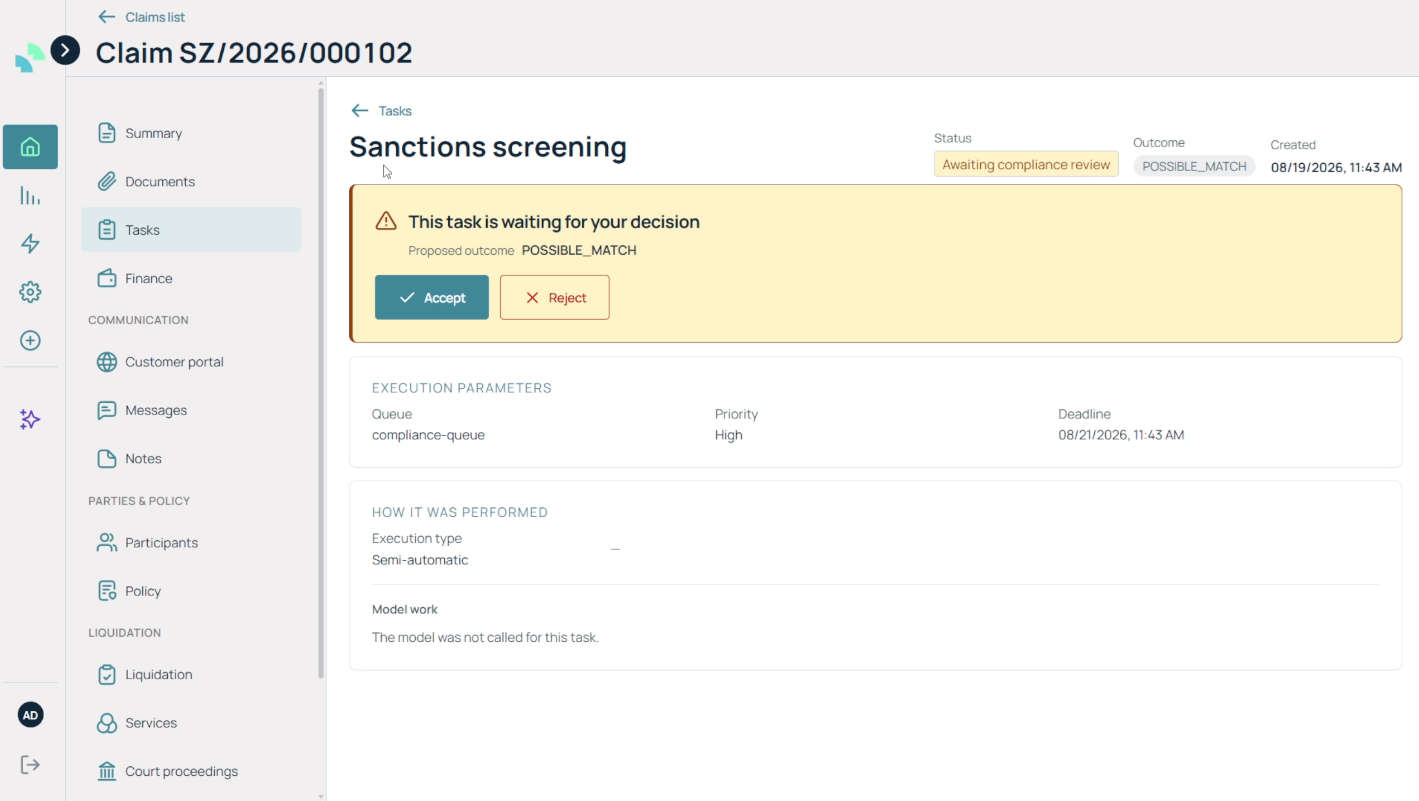
A material recommendation does not complete itself. It changes the task status to awaiting a human decision, routes to a named queue with a priority and a deadline, and waits there until someone with the right authority acts on it.
The Status Says It Plainly: Settlement evaluation produces an evaluated outcome and then holds at “awaiting settlement authorization.” The analysis is finished. The settlement is not.
Routed, Not Parked: Each pending decision carries its queue, its priority, and its deadline. Compliance matters go to the compliance queue; settlement matters go to claims operations.
Accept or Reject, On the Record: The reviewer’s action is recorded against the task alongside the outcome the system proposed, so the two are never confused for one another.
The Same Pattern Everywhere: Sanctions screening, settlement authorization, authority referrals, and compensability flags all present the same gate. Adjusters learn it once and recognize it everywhere.
Analysis you can challenge, not a score you have to trust
Claims leaders will not defend a number they cannot explain. Every material output shows what it looked at, why it flagged what it flagged, and what it wants a person to do about it - in claims language, not model language.
What It Reviewed: The documents, policy provisions, and data sources behind the analysis, each linked to its source - and an explicit note where information was unreadable, missing, or excluded.
Where the Recommendation Came From: Separate assessment dimensions with their own outcomes, so a file can be sound on coverage and exclusions while still being flagged on compensability - and you can see which one drove the result.
Built to Be Disagreed With: Recommendations are wrong sometimes, and a platform that hides that is a platform you cannot defend. The reviewer can reject the analysis, and the record keeps both the original output and the human disposition.
Governance You Can Show a Regulator
The defensibility argument in a bad-faith case is never “the model was correct.” It is that the organization ran a controlled process, documented the reasoning, applied the required authority, and kept human ownership of the decision.
Every step, attributed
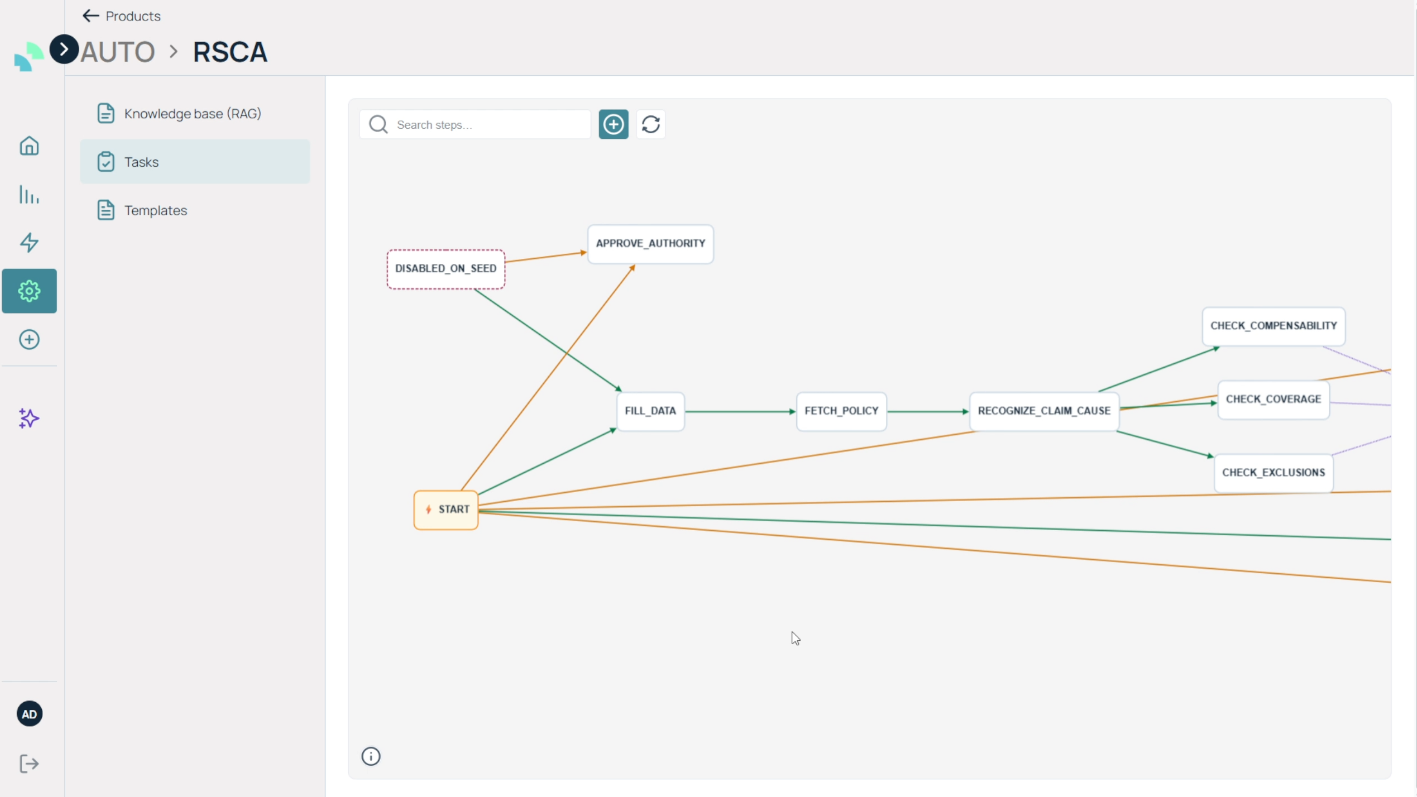
A routine property claim runs through sixteen steps. Each one is stamped with the time it completed and the name of whoever completed it - a person or the system. The record is built as the claim is handled, not assembled afterward when someone asks.
Step-Level Attribution: Every step carries its completion time, its execution type, and the user who performed it. Nothing in the history is anonymous.
The Machine-Human Split as a Number: The process record counts how many steps ran automatically, how many were AI-assisted, and how many a person performed. On any given file, that balance is a figure you can quote, not an impression you have to defend.
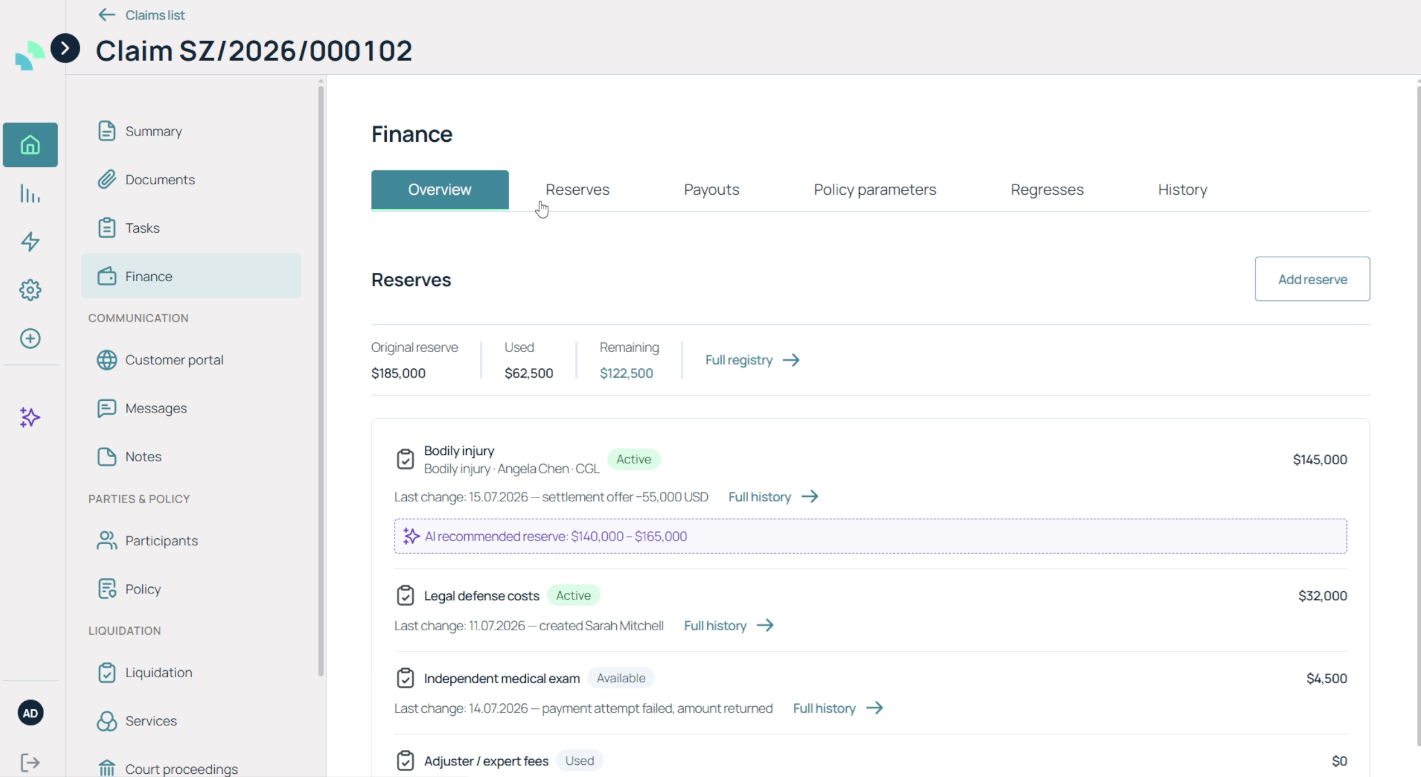
Financial History Preserved: Reserve changes keep the prior value, the revised value, the reason, and the date. Values are preserved rather than overwritten, so exposure development can be reconstructed.
Retrievable Under Examination: Management can move from an exception report into the underlying claim and read exactly what happened, in order, without a technical export.
.png)
Compliance-first by design, not retrofitted
Compliance requirements are applied inside the claim workflow rather than reported on afterward. The state of loss, the line of business, and the claim type determine which deadline applies, when it is due, and who owns it.
State-Level Compliance: Jurisdictional requirements applied by state of loss - acknowledgment windows, status communication intervals, payment timeframes, and statutes of limitation - with the applicable rule and its calculated date visible on the file.
Data Sovereignty: U.S. claim data is processed in the United States. In a bring-your-own-cloud deployment you own the AI infrastructure in your own tenancy and contract directly with the model provider.
AIS Program Evidence: Immutable, time-stamped records supporting DOI examinations, internal quality reviews, and NAIC AI Systems Evaluation Tool reviews. The architecture supports state privacy and cybersecurity requirements including CCPA and the New York DFS cybersecurity regulation, 23 NYCRR Part 500.
Human Decision Authority: AI organizes the workflow and prepares the analysis. Adjusters, supervisors, and coverage counsel retain authority over every regulated claim decision, and the record shows who exercised it.
Claims AI Software That Works With the Core System You Already Have
Replacing a core claims system is amulti-year program with its own risk profile. Most carriers do not need one tofix the problem in front of them. Claims AI is designed to operate as anintelligence, workflow, and analysis layer over the systems you already run.
Integration
Native connection to policy administration, billing, and underwriting. Document repositories, payment platforms, data warehouses, identity providers, weather services, and claims databases through documented APIs. How much of the workflow lives in Claims AI and how much stays in your core is a design decision made during discovery - a limited pilot may run on scheduled data feeds, while a production deployment typically needs real-time integration and write-back.
Multi-provider AI, no model lock-in
We select the model that fits each task rather than committing the whole pipeline to one provider. Switching providers is a configuration change. If a model is unavailable, the system fails over to a configured alternative and the queue keeps moving.
Insurance-native, not insurance-adjacent
Claims AI was built by a team that has spent twenty years implementing core insurance systems - policy administration, rating, claims. That shows up in the parts that generic tooling gets wrong: how endorsements modify a form, how authority actually cascades in a claims organization, what belongs in the official claim record and what does not.
Cost transparency
Per-claim cost broken down by extraction, analysis, and fraud checking. Weekly and monthly dashboards on time saved and system performance. No per-seat and no per-adjuster licensing - adding an adjuster to the workspace does not change what you pay.


Used by the World's Leading Companies

















A 60- to 90-Day Pilot on Your Own Files
Not a sandbox with our sample data. Five ofyour adjusters, one line of business, one jurisdiction, your real files, and afull audit trail from day one. We establish your current baseline beforeanything is deployed, so the result is measured against your numbers ratherthan against an industry average.
How Claims Decisions Actually Get Made in 2026
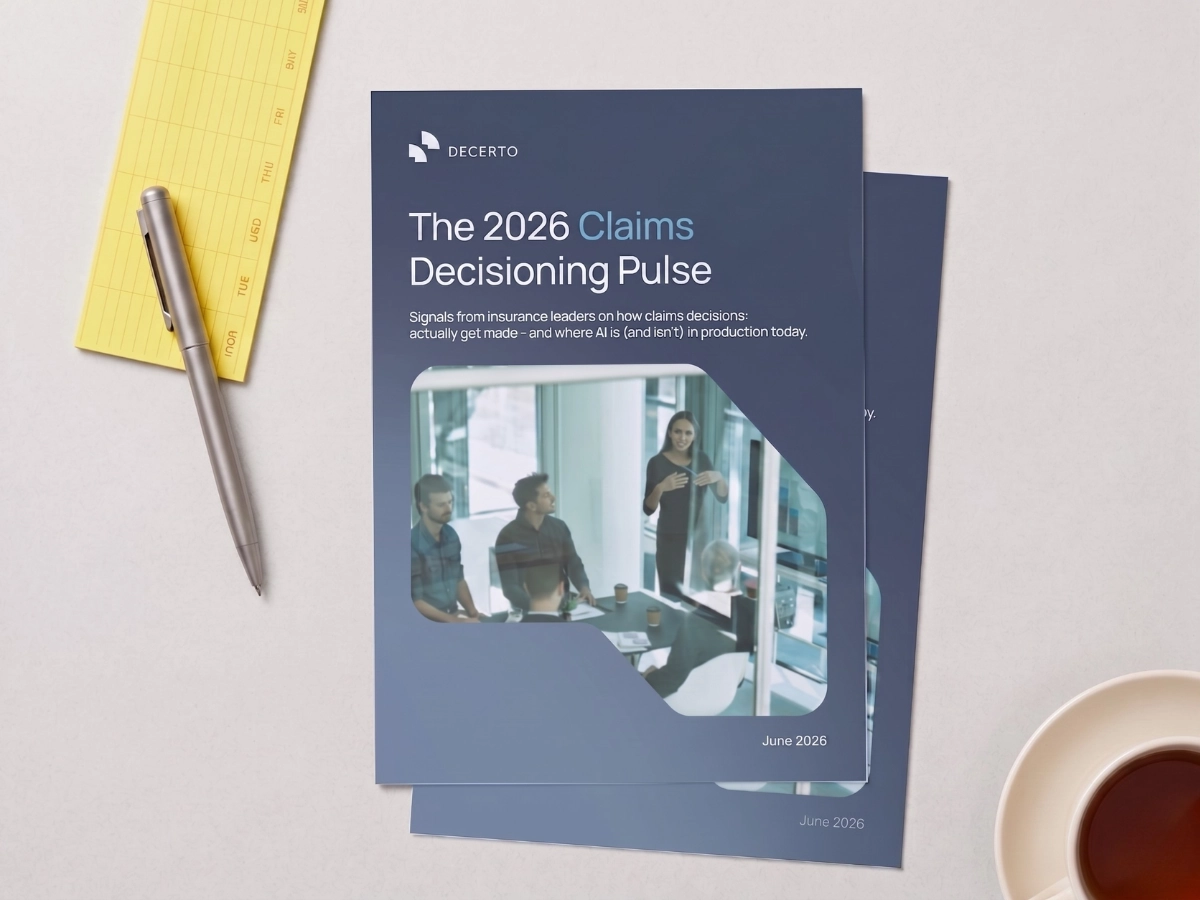
In May 2026, we asked U.S. claims leaders the same questions about how AI is actually deployed in claims operations today. The findings diverge from prevailing industry narratives — and from what vendors are pitching. Five operational signals, the NAIC regulatory framework, and a deployment playbook for VPs of Claims and CCOs.
FAQ
We've gathered answers to the questions we get asked most often.

No. Claims AI identifies relevant policy provisions, summarizes the facts, surfaces potentially applicable exclusions, and flags missing information. The coverage position is determined by an authorized claims professional, supervisor, or coverage counsel under your authority structure, and their decision and reasoning are recorded in the file.
No. Claims AI is designed to run as an intelligence and workflow layer over your existing core, connecting through APIs to policy administration, document repositories, and payment platforms. How much lives in Claims AI versus your core is decided during architecture discovery, based on what your systems expose.
The reviewer corrects, rejects, or escalates it, and the system keeps both the original output and the human disposition. That record is useful: it shows meaningful oversight rather than rubber-stamping, and it feeds the governance review that decides whether a rule or threshold needs adjusting.
It applies your configured jurisdictional requirements, creates the deadlines, escalates exceptions, and logs the evidence an AIS Program review asks for: what the system reviewed, what it produced, who reviewed it, and what they decided. Validating that the configured rules match your regulatory obligations remains your responsibility.
A focused pilot - one line of business, one jurisdiction, limited integrations, five adjusters - runs 60 to 90 days from scoping to measured result. A production deployment with real-time integrations, data migration, security review, and multi-jurisdiction configuration is scoped after discovery rather than estimated from a demo.
A general-purpose model can summarize a document. It does not know which user holds settlement authority, which state deadline is approaching, whether a reserve increase requires approval, or what belongs in the official claim record. The value is the workflow, authority rules, review requirements, escalation paths, and audit controls built around the analysis.
Defensibility comes from a controlled, documented process rather than from model accuracy. The record separates AI-generated analysis from the human action taken in response, and preserves the source material reviewed, the reason each issue was flagged, the reviewer’s identity and authority, any modifications, and the final disposition.
Yes. Workflows, authority levels, diaries, escalation rules, fraud weights, and communication templates are configurable by program, line of business, state, claim type, severity, and user role. Some changes are business configuration; others need development. Which is which is confirmed during implementation discovery.
U.S. claim data is processed in the United States. In a bring-your-own-cloud deployment you own the AI infrastructure in your own tenancy and contract directly with the model provider. Data flows, retention, subprocessors, and training restrictions are documented and confirmed during security review, before any pilot begins.
Adoption depends on whether the output is accurate, sourced, and visibly correctable. Adjusters who can see where a conclusion came from and reject it with one click tend to engage; those handed an unexplained score tend not to. We include adjuster participation, testing, and feedback in the pilot for that reason.
Still have questions?
If you didn’t find the answer to your question on our website, please contact us. We’ll get back to you within 24 hours.

Start With a 30-Minute Conversation
Tell us where your operation loses time - in claims, in underwriting, in policy servicing, or in getting a product to market. You will talk to a senior architect, not a sales team, and the first call is a technical Q&A rather than a walkthrough of screens.If a pilot makes sense afterward, we will scope one: one line of business, one jurisdiction, limited integrations, measured against your own baseline. If it does not, you will still leave with a clearer view of your own bottlenecks.