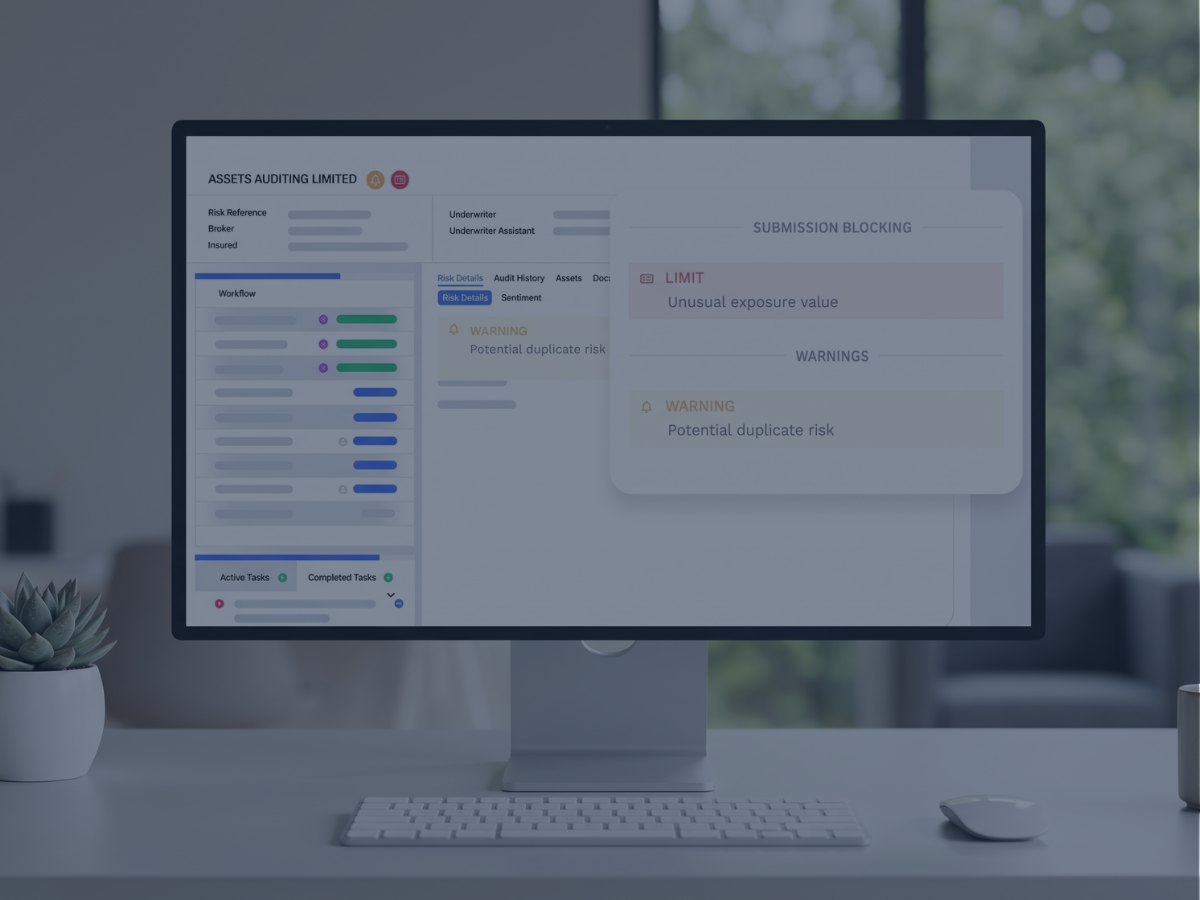

Why specialty and MGA underwriting needs different workbench capabilities
I have worked with specialty carriers writing cyber, ocean marine, aviation, equine, and agriculture risks. Every one of them gets the same demo from horizontal workbench vendors built for personal auto, and every one of them comes out of the demo asking the same question: can this actually handle our submission process? The answer depends entirely on how configurable the workbench data model and rules engine actually are, not how good the demo data looks.
Where horizontal workbenches struggle with specialty lines
Workbenches designed for high-volume, low-complexity standardized risks (personal auto, homeowners, small commercial) have data models and workflows that fit poorly with specialty lines for four consistent reasons.
Data model rigidity
A personal auto data model assumes vehicles, drivers, garaging addresses, prior loss data: a relatively fixed schema. Specialty lines need fundamentally different schemas. Cyber risk needs technology stack inventory, security control attestations, third-party data processor lists, and incident response capability. Ocean marine needs vessel manifests, voyage data, cargo schedules, and port-call patterns. Aviation needs aircraft type, pilot ratings, operating environment, and maintenance records. A workbench whose data model cannot accommodate these variations forces specialty underwriters back into Excel.
Submission processing assumptions
Standard personal and small commercial submissions largely arrive on ACORD Forms, the standardized forms ACORD has published since 1971 (the ACORD 125 commercial insurance application is the typical example). Specialty submissions arrive in carrier-specific or broker-specific formats: lengthy proprietary cyber risk questionnaires, vessel schedules in shipping company-specific spreadsheets, aviation logbooks. Document automation built for ACORD forms struggles with this variability. Modern workbenches with configurable document templates and trainable extraction models handle it; rigid templates do not.
Rule complexity per submission
A personal auto submission typically runs against a compact, stable rule set. A specialty cyber submission has to evaluate security controls, industry risk factors, jurisdictional exposure, and concentration limits at the same time, which multiplies the number of rules each submission touches. Workbenches with limited rule-engine scaling slow down or fail on specialty workloads.
Capacity and accumulation tracking
Specialty lines and MGA-written books have hard capacity limits that need real-time tracking: total capacity per cyber risk class, per geographic zone for property specialty, per industry vertical. Horizontal workbenches typically lack the real-time accumulation logic required, defaulting to monthly snapshots that miss capacity events between cycles.
For MGAs, these limits are contractual. The NAIC Managing General Agents Act (Model #225) requires every carrier-MGA contract to set underwriting guidelines that include the maximum annual premium volume, maximum limits of liability, the types of risks that may be written, and territorial limitations. Each of those is a limit the workbench should track as submissions arrive.
Five workbench capabilities that matter most for specialty carriers and MGAs
From the specialty carrier deployments I have advised on, five capabilities consistently separate workbenches that succeed in specialty environments from workbenches that need extensive customization or early replacement.
Configurable data model. The workbench must let you add new entity types, fields, and relationships without vendor engineering involvement. Cyber risk schemas should be configurable by the carrier; aviation risk schemas similarly. Vendor-controlled data model is a long-term constraint.
Trainable document extraction. OCR plus generative AI should be retrainable on specialty submission formats: your specific cyber risk questionnaire, your specific vessel schedules, your specific aviation logbooks. Pre-trained models designed for ACORD forms need retraining before they reach production accuracy on specialty formats, so ask each vendor how that retraining works and who owns it.
Real-time capacity and accumulation tracking. Aggregate exposure by class, geography, industry, or any custom dimension should be queryable in real time as new submissions arrive. Daily or monthly batch updates miss capacity events that drive specialty underwriting decisions.
Treaty allocation logic for MGA workflows. MGAs and delegated authority writers need automatic treaty allocation based on policy attributes, with bordereaux generation for capacity providers and reinsurers. Workbenches without native treaty allocation force MGAs into spreadsheet workarounds that defeat the purpose of automation (our overview of reinsurance automation processes covers the downstream steps). Note that allocation is not binding: under the NAIC MGA model act, binding authority for reinsurance contracts rests with an officer of the insurer who is not affiliated with the MGA, so the workbench should allocate and report while the carrier keeps binding control.
Rule-engine scaling for high rule counts per submission. Specialty submissions that evaluate against large rule sets need rule engines that handle that scale without degrading response time. Test the actual workload during vendor evaluation, and ask for measured execution times rather than marketing claims.
Configurable data models for specialty risks
The single most important architectural decision in a specialty workbench deployment is whether the data model is carrier-configurable or vendor-controlled. Carrier-configurable data models let your specialty underwriting team add new fields for emerging risk factors as the market evolves. Vendor-controlled data models route every new field through a vendor change request and the vendor's release schedule. We make the broader business case in why customization matters for niche insurance markets.
For cyber risk specifically, the market changes fast. The NAIC Report on the Cybersecurity Insurance Market (2025) shows U.S. cyber direct written premium fell about 7% to roughly $9.14 billion in 2024, while reported claims rose almost 40% to nearly 50,000, driven by ransomware, business email compromise, and credential abuse. The same report notes that U.S. cyber rates fell an average of 5% in the fourth quarter of 2024, the first quarterly decrease after seven years of rising rates. Regulatory exposure keeps shifting as well: all 50 states have enacted security breach notification laws, and insureds with EU customers also fall under the EU General Data Protection Regulation (GDPR).
Your data model needs to absorb new fields for these changes, plus new attestation frameworks, without vendor involvement. Specialty carriers on vendor-controlled workbenches wait for the vendor to add each new field, which delays the moment they can start pricing emerging cyber risk signals.
No-code rules authoring for fast product iteration
Specialty and MGA businesses compete on product iteration speed. New product variants, new endorsement options, new market segments: specialty MGAs win business by launching these faster than incumbent carriers running traditional tools, and the rules engine usually sets the pace.
No-code rule authoring lets your specialty underwriting director author and deploy new rules without waiting for an IT release cycle. Combined with impact simulation against the back-book, the result is iteration speed that specialty carriers actually need. That CUO-controlled rule layer is the core of the Higson underwriting workbench. For the broader treatment of why this matters across all P&C lines, see our top features article.
MGA-specific workflow: bordereaux, treaty allocation, capacity tracking
MGAs and delegated authority writers have workflow needs that pure carrier workbenches often miss. Three specifically: automatic bordereaux generation for capacity providers and reinsurers, in the format each one requires (for Lloyd's capacity, the Lloyd's Coverholder Reporting Standards, Version 5.2 define the core risk, premium, and claims data set); real-time treaty allocation as new policies bind, with automatic exception handling when treaty capacity is exhausted; and capacity tracking with alerts before limits are reached, not after they have been breached.
The regulatory frame makes this data non-optional. Under the NAIC Managing General Agents Act, which the NAIC adopted to guide state regulation of MGAs, the MGA must render accounts detailing all transactions to the insurer at least monthly, and the insurer must conduct an on-site review of the MGA's underwriting and claims operations at least semi-annually. A workbench that cannot produce that transaction-level record on demand turns every carrier review into a manual reconciliation exercise. For the wider operating context, see our articles on the challenges MGAs face and the core technology solutions for MGAs.
Modern workbenches built or configured for MGA workflows handle these natively. Workbenches built primarily for carrier-direct underwriting often require custom configuration that the MGA pays for. From the MGA technology evaluations I have advised on, MGAs should weight these MGA-specific capabilities heavily: they drive a large share of the day-to-day operational work that workbench technology should automate.
Specialty examples: cyber, ocean marine, aviation, equine, agriculture
Cyber risk underwriting needs technology stack inventory, security control attestation, third-party data processor mapping, incident response capability scoring, and concentration risk by sector and geography. Real-time accumulation by shared technology dependency (e.g., common cloud provider, common managed security service) is increasingly critical. The NAIC 2025 cyber insurance market report cites the July 2024 CrowdStrike incident as a non-malicious third-party event with widespread consequences, and notes that reinsurers increasingly require portfolio data from primary insurers to control aggregation and capacity risk.
Ocean marine needs vessel inventory, voyage history, cargo manifest evaluation, port-call risk scoring (sanctions, conflict zones, piracy risk), and per-voyage rather than annual policy structures for many lines. Sanctions screening is a data model question, not a checkbox. In its Sanctions Guidance for the Maritime Shipping Industry (October 2024), OFAC walks through a scenario in which hull underwriters request the flag state, beneficial owners, technical manager, operator, and two years of voyage history, and treats extended gaps in AIS transmission as a sanctions-evasion red flag.
Hull war and war risk exclusions add dynamic rule complexity because the underlying geography changes. The Joint War Committee of the LMA and IUA revised its Listed Areas for hull war, piracy, terrorism, and related perils at least three times in 2026 (JWLA-033 in March, JWLA-034 in July, and most recently circular JWLA-035 of 16 September 2026). Piracy exposure moves too: the ICC International Maritime Bureau recorded 38 incidents in the first half of 2026, the lowest since 1992, yet still warned of a slight resurgence of Somali piracy. Rules tied to these lists need to update in days, not in vendor release cycles.
Aviation underwriting needs aircraft type and registration, pilot ratings and experience hours, operating environment (corporate, charter, training, agricultural), and maintenance program adherence. Loss data integration with aviation-specific databases is a workbench requirement, not a nice-to-have. The NTSB's CAROL database and Aviation Investigation Search cover investigations from 1962 to the present with CSV and JSON downloads, while the FAA's Accident and Incident Data System (AIDS) holds incidents only and uses causal codes that differ from the NTSB's. The workbench has to map both sources into one loss view.
Equine, agriculture, fine art, kidnap and ransom, and other specialty lines each have their own data model requirements. The pattern is consistent: configurability matters more than out-of-the-box feature count, which is the same argument we make for specialty insurance software at the core-system level.
How to evaluate a workbench for specialty or MGA use
Three evaluation steps consistently separate good specialty workbench selections from ones that end in early replacement.
Require at least three reference customers in your specific line of business at comparable scale. A workbench vendor with strong personal lines references and one specialty reference is not a specialty workbench vendor: they are a horizontal vendor learning specialty. Let someone else be the first specialty deployment.
Run the vendor evaluation on your actual submission data. Demo data is curated; your data is messy. Give the vendor 10-20 of your real submissions and require them to demonstrate document extraction, rule evaluation, and decision logging against that actual workload. The accuracy gap between demo and production is consistently underestimated.
Validate the data model configurability claim. Ask the vendor to add a new entity type (a specialty-specific risk dimension) during the evaluation, with you watching. If it takes vendor engineers and a change request, you are looking at vendor-controlled, not carrier-configurable.
For the broader workbench selection criteria across all P&C lines, see our top features to look for article. For the comparison between modern workbenches and traditional underwriting tools, see workbench vs traditional tools. And for the foundational view of what an underwriting workbench is, see our underwriting workbench guide.
Frequently asked questions
Can a standard underwriting workbench handle specialty insurance lines like cyber or aviation?
It depends entirely on the workbench's data model configurability and rule-engine flexibility. Horizontal workbenches built for personal auto or small commercial often struggle with specialty schemas because their data models are fixed for high-volume standardized risks. A workbench with carrier-configurable data models, trainable document extraction, and rule-engine scaling for high rule counts per submission can handle cyber, ocean marine, aviation, and other specialty lines. For aviation, that means mapping loss data from both the NTSB's CAROL database and the FAA's AIDS incident records; for cyber, it means tracking accumulation by shared technology dependency, a risk the NAIC 2025 cyber insurance market report highlights. The vendor's reference customer base is the best predictor: three or more reference customers in your specific specialty line at comparable scale indicates real fit; a single specialty reference customer indicates vendor learning curve.
What underwriting workbench features matter most for MGAs?
Five workbench features matter most for MGA workflows beyond core underwriting functionality: automatic bordereaux generation in the format each capacity provider or reinsurer requires (for Lloyd's capacity, the Coverholder Reporting Standards, Version 5.2); real-time treaty allocation as new policies bind, with exception handling when capacity is exhausted; capacity tracking with proactive alerts before limits are reached; configurable data models for the specific lines the MGA writes; and a delegated authority audit trail that satisfies both the MGA's compliance needs and the carrier-of-record's oversight requirements. Those oversight requirements are concrete: the NAIC Managing General Agents Act (Model #225) calls for monthly transaction accounting from the MGA and an on-site review by the insurer at least semi-annually. From the MGA technology evaluations I advise on, these features drive a large share of the operational work that workbench technology should automate.
How does a specialty insurer customize an underwriting workbench for its specific market?
Three customization layers consistently matter. First, data model configuration adds new entity types, fields, and relationships specific to the line: cyber risk schemas, vessel manifests for marine, aircraft details for aviation. For marine, that includes the ownership and voyage-history fields that OFAC's 2024 maritime sanctions guidance describes underwriters requesting. Second, rule-engine authoring encodes the specialty-specific underwriting logic with no-code interfaces for the underwriting team. Third, document extraction training adapts OCR and generative AI models to the specialty's submission formats. The right architecture puts all three under carrier control rather than vendor control; vendor-controlled customization routes every change through vendor change requests and release schedules, a delay specialty carriers cannot afford as the market evolves.
How long does it take to deploy a customized underwriting workbench for a specialty carrier?
I do not know of a public industry benchmark for this, and timelines depend on scope, integrations, and how many lines of business go live first. A specialty deployment generally runs longer than a standard P&C line because of data model configuration and document extraction training. The phases are consistent: discovery, current-state mapping, and data model design; configuration, integration build, and document model training; UAT and a parallel run against existing tools; then phased cutover and optimization. Carriers that pick a workbench with strong references in their specific line usually move faster than those that pick a horizontal workbench and customize it heavily. I recommend asking every vendor for go-live timelines from named reference customers in your line, and treating any estimate without a reference behind it as a sales number.
What is the difference between a configurable workbench and a custom-built underwriting system?
A configurable workbench provides a productized platform with extensive carrier-controlled configuration: data models, rules, document templates, workflows, audit trail. Configuration happens in the workbench UI or low-code tooling by carrier staff. A custom-built underwriting system is engineered from scratch for the carrier, with full code-level customization. Configurable workbenches usually deploy faster and cost less because the platform already exists, and they benefit from vendor product roadmap updates. Custom builds give full control but take longer, cost more to build and maintain, and require sustained engineering depth. For mid-tier specialty carriers and MGAs, configurable workbenches are almost always the right choice; custom builds make sense only at enterprise scale or for unique business models.
How does Decerto Higson compare to Guidewire for specialty MGAs?
Higson is built for U.S. P&C carriers in the $500M-$5B GWP range with strong configurability for specialty and MGA workflows. According to the Higson product page, its rules engine executes rules in about 0.23 ms in typical use and handles 9,000 requests per second. Guidewire PolicyCenter is the standard choice for $5B+ enterprise carriers that need a broad, full-suite platform. My take, after 20 years on the carrier side advising on vendor selection: for specialty carriers and MGAs in the $500M-$5B range, configurability and underwriter control over rules usually matter more than suite breadth. For $5B+ enterprise carriers writing across personal, commercial, and specialty lines globally, Guidewire is the appropriate choice. Higson is not built for that scale and we say so explicitly.
Talk to Decerto about Higson
If you are a Chief Underwriting Officer or VP Underwriting at a U.S. P&C carrier in the $500M-$5B GWP range, and your current underwriting workflow runs on a mix of PAS screens, Excel rating sheets, and email-based broker submissions, that is the exact pattern the Higson underwriting workbench was built to address. Higson gives the underwriting team a CUO-controlled rules engine, so rule changes do not wait for an IT release cycle. According to the Higson product page, the engine executes rules in about 0.23 ms in typical use and handles 9,000 requests per second. For delegated authority business, see our solutions for MGAs and brokers.
My take, after 20 years on the carrier side: Higson is not the right fit for $5B+ enterprise carriers running multi-region multi-currency books across 30+ jurisdictions. Guidewire is. Higson is built for U.S. P&C carriers in the $500M-$5B GWP range that need rules-engine control and audit-grade documentation without a multi-year PAS replacement.
Sources
- ACORD. ACORD Forms: standard forms for the insurance industry. Accessed 2026-09-30.
- National Association of Insurance Commissioners (NAIC). (2002, October). Managing General Agents Act (Model #225). NAIC Model Laws, Regulations, Guidelines and Other Resources. Accessed 2026-09-30.
- National Association of Insurance Commissioners (NAIC). (2025, November). Report on the Cybersecurity Insurance Market (2024 data year). Accessed 2026-09-30.
- National Conference of State Legislatures (NCSL). Security Breach Notification Laws. Accessed 2026-09-30.
- European Parliament and Council of the European Union. (2016, April 27). Regulation (EU) 2016/679: General Data Protection Regulation. Official Journal of the European Union, L 119. Accessed 2026-09-30.
- Lloyd's. (2019, August 20). Lloyd's Coverholder Reporting Standards User Guide, Version 5.2. Accessed 2026-09-30.
- U.S. Department of the Treasury, Office of Foreign Assets Control (OFAC). (2024, October 31). Sanctions Guidance for the Maritime Shipping Industry (OFAC Compliance Communiqué). Accessed 2026-09-30.
- Joint War Committee (LMA/IUA). (2026, September 16). JWC Listed Areas: Hull War, Piracy, Terrorism and Related Perils, Circular JWLA-035. Accessed 2026-09-30.
- ICC International Maritime Bureau. (2026, July 9). Maritime piracy incidents fall to lowest since 1992, but risk remains (Piracy and Armed Robbery Against Ships Report, January-June 2026). Accessed 2026-09-30.
- National Transportation Safety Board (NTSB). (2023, July 17). NTSB Improves CAROL and Aviation Investigation Search Functions on Website. Accessed 2026-09-30.
- Federal Aviation Administration, Aviation Safety Information Analysis and Sharing (ASIAS). Accident and Incident Data System (AIDS): Business Rules. Accessed 2026-09-30.

Subscribe to receive the latest blog posts to your inbox every week.